So here it is guys, the post I promised on the effects of La Nina. Currently there is a lot of monitoring (unlike India) by the met department of Australia on developments of El Nino and La Nina because Australia goes through cycles of droughts (El Nino) and excess rainfall (La Nina). You can get regular updates on this here.
Based on the data collected so far, it seems there is a strong possibility of a La Nina being formed by the end of this year. Whether it will be a severe La Nina or a mild one, it can be only known after a couple of months. The El Nino this year was not as severe as the ones in 1983 or 1998.
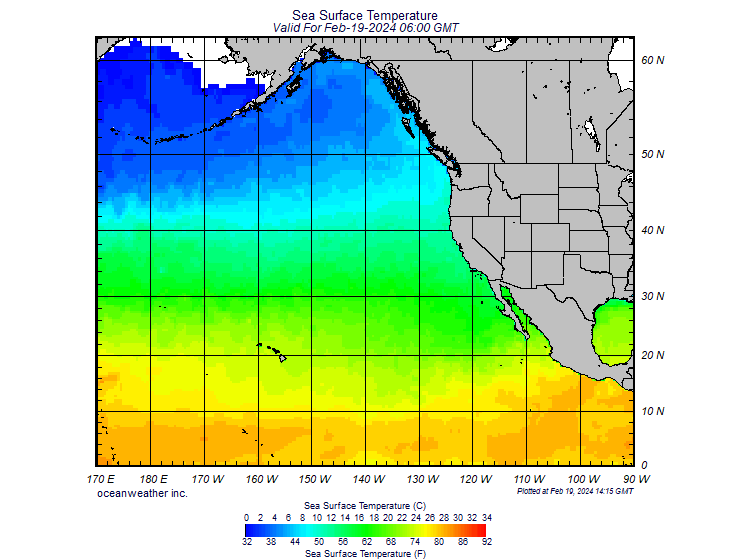
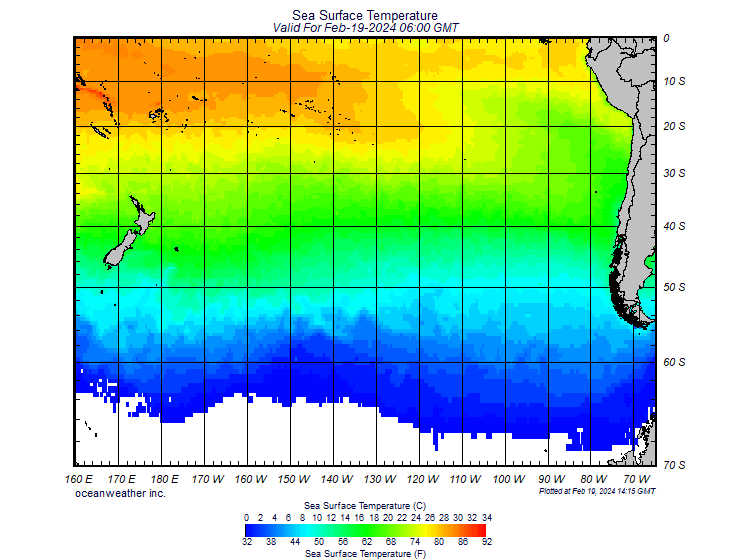
You can also check the current sea surface temperatures in the eastern Pacific area at the Equator to see how the sea is cooling faster than normal (a strong symptom of La Nina).
This cold water would be pushed towards the Indian Equator through the North and South Equatorial currents from the Pacific ocean through December to April if a La Nina truly sets in so by the summer of 2011, the Indian ocean will be cooler during summer of next year thank what it has been this year and than what is normal for an average year.
So what effect does a La Nina have on the rainfall patterns in India. My guess would be exactly the opposite of what has happened till now. This will definitely create a situation for increased precipitation over peninsular India which effectively means not only a normal monsoon but excessive rains over India because of the larger than normal precipitation. The reason will be solely because the colder water in excess will be pushed from the Pacific due to the potential La Nina causing a larger than normal high pressure area in the Indian Ocean causing higher moisture to be pushed to India because India would be having its summer during that time. Of course I cannot prove all this with data because all of this is to happen in the future but I would surely be tracking this and the movement of the precipitation through summer of next year and be posting about the same.
At an overall level, a La Nina causes excess rainfall in India which can very likely cause floods in the areas where India is experiencing droughts. This is generally the behavior since La Nina is just the opposite of El Nino hence the weather effects are generally the opposite. So I expect to see reduced rainfalls in parts of southern India (read farmer suicides in Telengana and Vidharbha). Northern and eastern India should have record rainfall which can very well cause floods given the state of the water management and infrastructure in our country. Western India generally should get the same amount of rainfall because the south west monsoons should behave normally unlike this year (see my earlier post on this topic).
You can get a simplistic and nice demonstration of the El Nino and La Nina effect with its effects on the weather and precipitation over here.
I only wish that the met department of India start following data such as these to correctly predict the movement and intensity or lack of monsoons such that the agriculture based economy of India can be better prepared for the shocks due to lack of monsoons or floods. Moreover these studies of the weather patterns and phenomenon would greatly help predictions regarding the arrival and timing of the monsoons to be correct such that the typical Indian farmer can plan sowing of crops to ensure better harvests helping to keep inflation under check. Hope we get some more satellites for study of weather patterns, ocean currents, sea temperatures over the Indian peninsula instead of having only satellites for watching stupid reality shows.
So guys I am back after a while. I was busy observing what I have been saying and the past weeks have reinforced my observations and beliefs about the 2010 monsoons whatever the BS the government of India wants to spurt about the monsoons. The behavior and the effect of the El Nino has been really interesting. Record monsoons in Rajasthan including the Thar dessert (Pushkar lake has water for the first time in two years). Probably if we have some repeated El Nino events, the camels would become extinct. Gujarat has had 100% more rains than average till date. Check the latest rainfall distribution from the IMD website below.

Its obvious that such high rainfall restricted to certain parts of the country will cause floods (recent example of Gujarat getting flooded including Ahmedabad airport) while Bihar and Gangetic West Bengal is experiencing droughts. All this when the patterns were right out there for the met department and for us to see. Unfortunately the country is never prepared for any exigency. Dont read too much about floods in Delhi. Its the handiwork of the incredibly inefficient preparations for the Commonwealth Games and the associated corruption. Delhi and the NCR region is still under drought as per the above figure.
The met department has suddenly become very quiet now and not coming out with bold statements about the monsoons. The government is now biting its nails wondering what would the combination of the failed kharif crops (whose effect would be evident at the end of the year) and the wastage of foodgrains would do to inflation. They are banking on probably the Commonwealth Games to distract its citizens which no doubt would be another fiasco. If they are hoping that suddenly there would be a spurt of rainfall in the drought regions to make up for the deficiency, God help us because the folks out there would be swept away in floods.
Inflation would probably reach the levels of last year by the end of this year (close to 18-20%) instead of what the two Alices in Wonderland (Montek Singh Ahluwalia and our own Prime Minister) are predicting of inflation reaching 5% which would break the backs of the poor.
Worse times are coming coupled with the fact that the overall growth world over will come to a standstill. Lets hope for some sort of a miracle.